Can 304 Welded Pipe Deliver Reliable Performance in Food and Beverage Processing?
Yes — 304 welded pipe can deliver dependable performance in food and beverage processing when sourced from a certified manufacturer with verified material chemistry. Built from UNS S30400 austenitic stainless steel with approximately 18% chromium and 8% nickel, this pipe grade resists corrosion from cleaning agents, mild acids, and process fluids common in food production lines. When manufactured to ASTM A312 or ASTM A358 standards with internal weld bead removal and full solution annealing, the weld joint achieves a strength efficiency factor of 1.0 — equal to the base metal itself.
Understanding 304 Welded Pipe: Properties and Specifications
Chemical Composition That Supports Food Safety
Because 304 stainless steel is made of 18Cr-8Ni, it makes a passive oxide layer on the top of the pipe that fixes itself. This layer stops iron from getting into food, which is required by FDA 21 CFR and EU Regulation 1935/2004 for materials that come into contact with food. The carbon level is kept at 0.08%, which lowers the chance of sensitization while welding.
Mechanical Properties Worth Knowing
ASTM A312 says that 304 welded pipe must have a minimum yield strength of 205 MPa and a tensile strength of 515 MPa. It has a mass of 7.93 g/cm³ and can be bent even at very low temperatures. Because of these qualities, it can be used in both low-pressure steam uses in food plants and beverage lines that work at room temperature.
Standards and Size Range
The outside diameters of pipes made to ASTM A312, ASME SA312, ASTM A358, and EN 10217-7 range from 1/4" to 48" (DN8 to DN1200), and the wall thickness ranges from SCH 5S to SCH 80S. Standard lengths are 6 m and 12 m, but you can also get it cut to any length you need. This range of sizes meets almost all of a food or beverage facility's flow needs.
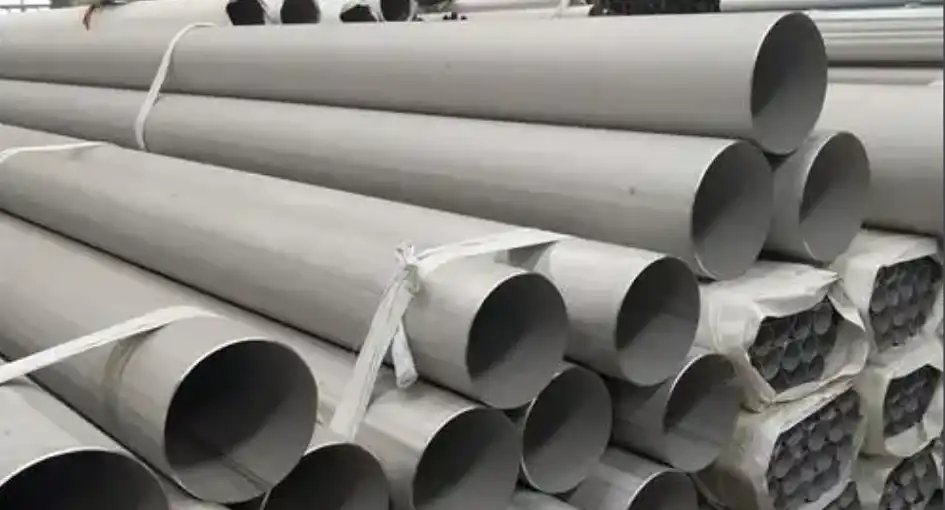
Advantages of Using 304 Welded Pipe in Food and Beverage Processing
Because it is useful rather than for marketing reasons, 304 stainless steel has been used regularly in the food business for decades. Here are the main success factors that make it the best choice:
- Corrosion resistance to CIP chemicals: Clean-in-Place (CIP) cycles typically use caustic soda (1–3% NaOH) and nitric acid solutions. 304 stainless resists both at standard process temperatures, preventing pipe wall degradation between batches.
- Smooth internal surface for hygienic flow: When the internal weld bead is removed flush and the pipe is bright annealed or pickled, the Ra surface roughness can reach below 0.8 µm — a threshold widely cited in 3-A Sanitary Standards and EHEDG guidelines for preventing bacterial adhesion.
- Cost-to-performance balance: Independent sourcing data consistently shows 304 welded pipe priced 30–50% lower than its seamless counterpart of the same diameter, with no measurable performance difference in low-to-medium pressure food applications.
Resistance to corrosion caused by CIP chemicals: Solutions of caustic soda (1–3% NaOH) and nitric acid are often used in Clean-in-Place (CIP) processes. 304 welded pipe stainless steel doesn't react with either at normal process temperatures, so the pipe walls don't break down between runs.
Comparing 304 Welded Pipe With Other Pipe Types for Food & Beverage Industry
304 Welded vs. 316L Stainless Steel
316L adds 2–3% molybdenum, which makes it much more resistant to chloride pitting. If you need to clean with brine, saltwater, or high-chloride chemicals, 316L is the right choice. 304 is a cheaper material that works just as well for standard dairy, juice, brewing, or bottled water lines.
304 Welded vs. Seamless Pipe
Seamless pipe doesn't have a lengthwise weld seam, which is good for uses with high pressure or high cycle wear. Welded pipe that meets ASTM A312 with 100% Eddy Current Testing and optional radiographic inspection on welds works just as well for food processing lines that work below 150 psi and 200°C. It is possible to see and prove that the cost benefits are real.
304 Welded vs. Carbon Steel and Galvanized Pipe
When it's wet and acidic, carbon steel and galvanized pipe rust. Zinc can leak out of galvanized coats and into food, which is against FDA rules. If you switch to 304 stainless steel, you won't have to worry about contamination or replacing pipes as often, which lowers your total cost of ownership over the life of an asset, which is 10 to 15 years.
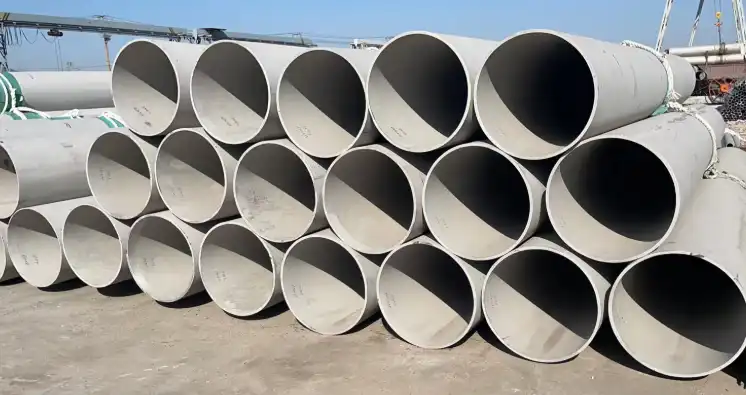
How 304 Welded Pipe Is Manufactured and Quality Controlled?
Welding Process and Heat Treatment
At Hebei All Trust Steel Co., Ltd, premium-grade steel strip is used to make 304 welded pipe through automatic TIG, Plasma, or Laser longitudinal welding. Every pipe goes through full post-weld solution annealing, which involves heating it to about 1050°C and quenching it with water. This recrystallizes the weld zone, normalizes the heat-affected area, and restores the passive corrosion-resistant layer.
Non-Destructive and Destructive Testing
Before being shipped, each batch of pipes goes through a set of tests that have been written down. The testing protocol has the following:
- Eddy Current Testing (ECT): 100% coverage for surface and sub-surface weld defects
- Hydrostatic Testing: Confirms pressure containment under service conditions
- Radiographic Inspection (RT/X-ray): Optional on weld seams for high-specification orders
- Flattening and Tensile Tests: Verifies mechanical ductility and seam integrity
You can use PMI (Positive Material Identification) research to find out the exact amounts of Cr and Ni in 304 welded pipe. This solves one of the biggest problems procurement teams face: getting the wrong or replacement material.
Certifications Provided
All Trust gives out EN 10204 3.1 Mill Test Certificates (MTC) that can be fully tracked by heat. There can be an inspection by a third party from SGS, BV, TUV, DNV, or ABS. For orders that need to follow European rules, we can provide documentation in ISO 9001:2015, CE, and PED formats.
Procurement Considerations for 304 Welded Pipe in Food Processing
Flexible MOQ and Lead Times
It is known that high minimum order quantities make it hard for medium-sized manufacturers to keep their cash flow in check. All Trust allows trial orders and small-batch development with a flexible low MOQ. Stock orders are shipped in 3–5 days, and normal custom orders are completed in 15–20 days. Lead times are stable because we keep over 5,000 tons of product in stores near Tianjin, Shanghai, and Qingdao.
Packaging That Protects Product Integrity
Transit damage, like dents, scratches, and surface rust, has a direct effect on how many inspections pass and how long it takes to finish a project. All Trust packs pipe in hexagonal bundles with plastic end caps, secure covers for each piece, waterproof bags for packing, and steel strapping. Heavy lifting slings that are rated for the gross weight of each pack are put inside sea freight bundles.
Documentation and Traceability for Export Orders
For people who want to buy ASTM-compliant pipe for projects in Southeast Asia or the Middle East, each batch has a unique heat number that is linked to the original mill certificate. Full traceability helps with clearing customs, meeting end-client documentation needs, and third-party inspections before shipping.
Conclusion
304 welded pipe works well in food and drink preparation settings when it is made according to ASTM A312 and the right steps are taken to anneal it, remove the weld beads, and check the material's chemistry. It doesn't react with CIP chemicals, has a clean surface, and has the right mechanical qualities for normal process piping. Plus, the price is right for medium-sized producers. The important thing is to buy from a seller that gives you traceable MTCs, lets a third party check, and ships without reducing the size of the items.
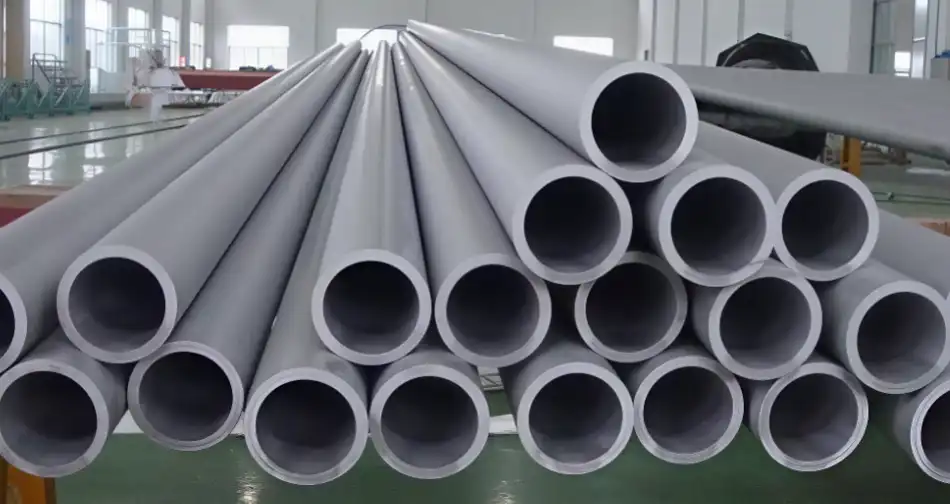
FAQ
How do I verify that a 304 stainless pipe has the correct Cr and Ni content?
Along with the EN 10204 3.1 Mill Test Certificate, you should ask for a PMI (Positive Material Identification) test report. PMI uses X-ray fluorescence (XRF) to make sure that each pipe has the right mix of chemicals. Any seller you can trust will gladly give this to you.
Is 304 welded pipe suitable for high-temperature food processing?
Of course, within reason. 304 stainless steel can be used continuously at temperatures up to about 870°C when it is rusting, but this is not recommended for food uses. SCH 10S or SCH 40S 304 welded pipe to ASTM A312 works fine for steam lines or scalding loops below 200°C at normal pressures.
What is the difference between 304 and 304L in welded pipe applications?
The highest amount of carbon in 304L is less than in 304 (-0.03% vs. -0.08%), which means that less carbide will form in the heat-affected zone during welding. 304L is sometimes asked for when wall widths are less than 2 mm or when multiple passes are needed to weld food-grade parts together. 304 with the right post-weld annealing is enough for most standard food line installations.
Does the weld seam affect the pipe's corrosion resistance?
If the metal is made correctly, with full solution annealing and passivation, the weld zone gets its passive oxide layer back and has the same corrosion resistance as the base metal. The Weld Seam Decay Test, which is part of All Trust's standard quality protocol, proves this.
Get Your Certified 304 Welded Pipe Quote From All Trust
Hebei All Trust Steel Co., Ltd is the company to contact if you are a buyer who needs a 304 welded pipe provider that can be tracked, meets ASTM A312, has a variable minimum order quantity, and has quality records that can be seen. Our team gets back to you within an hour during business hours, whether you need a small amount of prototypes or a full production run. Send us an email at info@hballtrust.com right now to get an MTC sample, a material sample, or a competitive price quote.
References
1. ASTM International. ASTM A312/A312M: Standard Specification for Seamless, Welded, and Heavily Cold Worked Austenitic Stainless Steel Pipes. ASTM International, 2022.
2. European Hygienic Engineering & Design Group (EHEDG). EHEDG Guideline Doc. 8: Hygienic Design of Food Processing Equipment. EHEDG, 2018.
3. 3-A Sanitary Standards, Inc. 3-A Sanitary Standards for Stainless Steel Tubing, Number 68-03. 3-A SSI, 2019.
4. ASM International. ASM Handbook, Volume 13B: Corrosion: Materials. ASM International, 2005.
5. Llewellyn, D.T., & Hudd, R.C. Steels: Metallurgy and Applications, 3rd Edition. Butterworth-Heinemann, 1998.
6. U.S. Food and Drug Administration. FDA 21 CFR Part 177: Indirect Food Additives — Polymers; and Food-Contact Materials Guidance. FDA, 2020.

