TP304 Pipe Supplier Solutions for Chemical Equipment, Storage Tanks, and Process Lines
When your production line depends on fluid integrity, one wrong material choice can shut down an entire operation. TP304 pipe — the industry's most widely specified austenitic stainless steel grade — delivers proven corrosion resistance, consistent wall tolerance, and full ASTM A312 compliance for chemical equipment, storage tanks, and process lines. At Hebei All Trust Steel Co., Ltd, we supply certified TP304 stainless steel pipe with EN 10204 3.1 MTCs, low MOQ flexibility, and delivery in ≤15 days, giving procurement managers the confidence to order with zero guesswork.
Understanding TP304 Pipes: Specifications, Properties, and Applications
Chemical Composition and Metallurgical Profile
The stainless steel TP304 (UNS S30400) is austenitic and in the "18-8" family. 18.0 to 20.0% of it is chromium, 8.0 to 10.5% is nickel, and 0.08% is carbon. An austenitic structure is formed by this mix. It is steady, not magnetic, and doesn't rust up to 870°C (1600°F). It can be pulled apart at least 515 MPa (75 ksi) and must not be stretched more than 205 MPa (30 ksi). As per ASTM A312, the numbers given are correct, and they are checked by PMI analysis and tensile tests on every production heat.
Standard Specifications and Dimensional Range
We sell Tp304 pipe that complies with ASTM A312 / ASME SA312 / ASTM A213 / EN 10216-5 / ASTM A249. As well as cold drawing and cold rolling, hot finishing and welding (ERW/EFW) can also be used. The OD runs from 13.7 mm to 609.6 mm, which is µ" to 24". The wall schedules range from SCH 5S to SCH 160 and XXS. You can pick a standard length of 5.8 m, 6 m, 11.8 m, or 12 m, or you can pick a random length of one or two meters. You can get a surface finish that is bright annealed (BA), satin, or mirror polished (up to 600#).
Industrial Applications Across Key Sectors
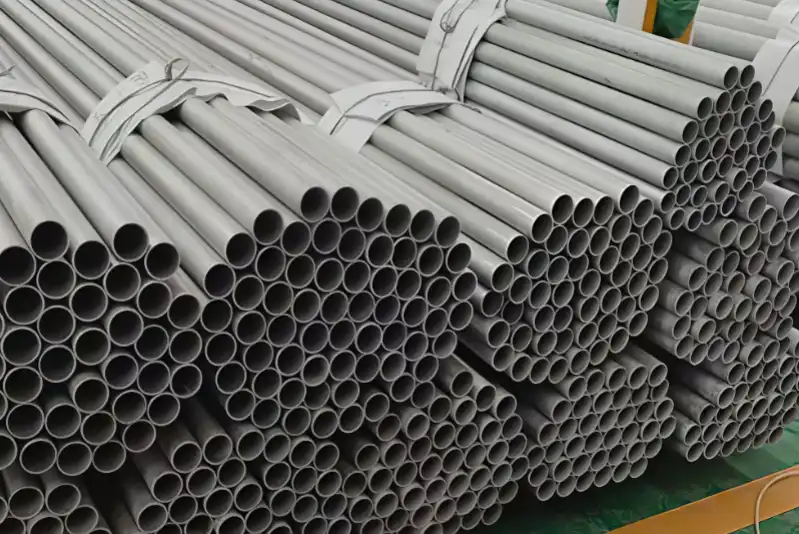
304 stainless steel pipe is used in a lot of different process industries. Light liquids, organic acids, and process water lines can all be used with it at room temperature in chemical processing. Its non-reactive surface lets the food and drink industry use Clean-In-Place (CIP) cleaning without getting metal on it. The fact that it doesn't rust and has a long life makes it useful for local waterworks and urban water supply networks. Most of the time, this grade is also used to make storage tank nozzles, heat exchanger shells, and structural support frames for OEM machinery.
Comparing TP304 Pipes with Alternative Materials: Helping You Decide
TP304 vs. TP316: When Chloride Exposure Is the Variable
TP316 adds 2.0–3.0% molybdenum, which raises pitting resistance in chloride-heavy environments like seawater or high-salt process streams. If your application involves direct exposure to chlorides above 200 ppm or acidic media such as hydrochloric or sulfuric acid at elevated concentrations, TP316 or TP316L is the stronger specification. For moderate chemical exposure — organic solvents, dilute acids, food-grade fluids, and process water — TP304 provides equivalent corrosion protection at a lower material cost, making it the preferred economic choice for the majority of chemical plant applications.
TP304 vs. TP304L and TP321: Welding and High-Temperature Considerations
tp304 pipe TP304L limits carbon to ≤0.03%, suppressing carbide precipitation at weld heat-affected zones. For heavily welded assemblies or thick-section fabrications, TP304L reduces sensitization risk without post-weld annealing. TP321 adds titanium as a stabilizer and is specified for sustained high-temperature service (above 425°C). If your process lines operate below 425°C and involve intermittent welding with light wall pipe, standard TP304 remains code-compliant and cost-effective. The decision ultimately rests on operating temperature, weld frequency, and projected service life.
TP304 vs. Carbon Steel: Total Cost of Ownership
Carbon steel costs less per kilogram, but its corrosion rate in chemical and fluid transit environments generates ongoing maintenance, coating, and replacement costs that erode the initial price advantage. A 2019 study published in Corrosion Engineering, Science and Technology confirmed that austenitic stainless steel piping in water treatment service maintained structural integrity for over 25 years with minimal intervention, compared with 7–10 years for uncoated carbon steel. For export orders destined for the Middle East or Southeast Asia, international buyers frequently mandate stainless specifications to meet local project codes.
Procurement Insights: How to Source Reliable TP304 Pipe Suppliers?
Certification Verification as a Non-Negotiable First Step
Before you look at prices, make sure you get the EN 10204 3.1 Mill Test Certificate for every heat. On a legal MTC, you can find the heat number, chemistry make-up, mechanical test results, and the stamp of the person who checked it. Compare the Cr and Ni values to the ranges shown in the ASTM A312 table. At All Trust, every package has a tracked MTC on it, and before the cargo is released, it is welcome and encouraged that SGS, BV, TÜV, DNV, Lloyd's, or ABS look it over.
Evaluating Stock Depth and Lead Time Commitments
How well your production plan works will depend on how much stock you have. Stock orders can be filled in 3–5 days by suppliers who keep more than 5,000 tons of rolling inventory. This includes 304, 304L, 316, and 316L standard round pipe. For custom sizes or plans, get written confirmation of the time it will take to make them. Being close to the ports of Tianjin, Shanghai, Qingdao, and Shenzhen means that All Trust can keep its delivery claim of 15 days for medium-batch orders.
Negotiating Low MOQ and Value-Added Processing
For businesses that make a lot of different SKUs for a lot of different projects, having a high MOQ can tie up their operating cash. You should talk about minimum order amounts by line item instead of total order weight when you're shopping. Like any other job, you should know how to do fixed-length cutting, pipe beveling, threading (NPT/BSPT), and end-cap fitting. This kind of processing gets rid of the need for machining further down the line, which means that less work needs to be done on the production floor.
Best Practices for Identifying and Verifying TP304 Pipes on Site
Reading Mill Markings and Heat Numbers
The name or brand of the company that made the real ASTM A312 pipe is stenciled on it, along with the material grade (TP304), standard number (A312), pipe schedule, heat number, and NDE test method. Any pipe that doesn't have heat numbers that can be tracked should be put somewhere else and tested again before it is put in place. Compare the heat number that was stamped with the MTC that came with the package. It's clear that the package should be turned down if they don't fit.
Applying Non-Destructive Testing Protocols
Four types of NDT can be used to check tp304 pipe stainless steel lines that are going in. The eddy current test finds flaws on the surface or very close to the surface of cracks that were welded. Ultrasonic testing (UT) can find holes inside and different wall thicknesses. Hydrostatic testing shows that the system works at the right pressure and doesn't leak. RT/X-ray testing is used when a deal needs to approve the quality of a weld. All Trust tests every piece of connected pipe with eddy current and the whole line with hydraulic testing before sending it out.
Confirming Wall Thickness Tolerance Compliance
ASTM A312 lets seamless pipe have a negative wall thickness mistake of -12.5%. If the variance is too high above this limit, it can be hard for lower-level neighborhood sellers. As soon as you get it, use an ultrasonic thickness gauge that has been calibrated to check the wall thickness several times around the outside. Write down the numbers and compare them to the record of the MTC measurement. If the number is regularly below the tolerance, you should get in touch with the seller and ask them to fix the problem before the batch is put into production stock.
Why Choose Our TP304 Pipe Solutions for Your Chemical Processing Needs?
Quality Control Backed by a Four-Step System
There are four different quality control points at Hebei All Trust Steel Co., Ltd. These are a spectrographic audit of the raw materials, real-time laser physical measurement during production tracking, independent NDT and destructive testing, and getting the paperwork signed off. This process gets rid of any Cr/Ni content that isn't up to par, checks for any dimensional issues before the items are sent out, and makes sure that each EN 10204 3.1 MTC that you receive is real and can be tracked.
Here are the main reasons why our service is worth it for every order:
- Certified Material Quality: 100% virgin austenitic stainless steel with guaranteed Cr and Ni content, zero recycled scrap input, and full PMI reporting available on request.
- Flexible Order Sizing: Low MOQ is available for custom dimensions and special schedules, reducing capital lock-up for medium-sized manufacturers managing multiple product lines.
- Protective Export Packaging: Pipes ship with plastic end caps, individual sleeves, steel strapping, and fumigation-free wooden cases, protecting surface finish and preventing transit damage across long export routes.
- Third-Party Inspection Acceptance: SGS, BV, TÜV, DNV, Lloyd's, and ABS inspections are all accepted, supporting export compliance for orders destined for Southeast Asia, the Middle East, and beyond.
The material is 100% brand-new austenitic stainless steel that has a guaranteed amount of Cr and Ni. It's not made from recycled materials, and you can get full PMI reporting if you ask for it. Low MOQ is available for custom sizes and special plans, which helps medium-sized makers who make a lot of different products keep their capital free.
When pipes are exported, they are protected with plastic end caps, individual bags, steel strapping, and wooden cases that have not been fumigated. This protects the finish on the top and keeps it from getting damaged on long export routes.
Acceptance of Third-Party Inspections: All of these are accepted: SGS, BV, TÜV, DNV, Lloyd's, and ABS. This helps make sure that orders going to Southeast Asia, the Middle East, and other places follow the rules for exporting.
Production Capacity and Delivery Reliability
Good materials, late deliveries, and damaged packaging are the problems that purchasing managers in the chemical equipment and food machinery manufacturing industries most often talk about when they buy things. These service commitments directly address these issues.
Conclusion
It is still one of the safest materials for chemical tools, holding tanks, and process lines to use tp304 pipe stainless steel pipe. It is a good choice for a lot of different working situations because it doesn't rust, works well mechanically, and doesn't cost much. Picking a provider rests on how well their paperwork is filled out, how quickly they can deliver, and how well they follow measures. The core buying standard for steady supply, real materials, and medium-batch production is met by Hebei All Trust Steel Co., Ltd. They offer traceable certification, flexible order terms, and quick expert support.
FAQ
What standard governs TP304 pipe for chemical process applications?
One of the main standards for TP304 pipe is ASTM A3112. This pipe is used for general toxic work and can be straight or soldered. ASME SA3112 is the code standard for pressure tanks that is the same. Heat exchanger tubes are made with ASTM A213. There is full EN 10204 3.1 MTC paperwork on the pipe that All Trust sells that shows it meets these standards.
How do I confirm the Cr and Ni content in delivered pipe?
A PMI (Positive Material Identification) test when the item is delivered. A small XRF tester can confirm the amounts of nickel and chromium in minutes.
What is the maximum negative wall thickness tolerance under ASTM A312?
ASTM A312 says that a seamless pipe's wall thickness can be off by up to 12.5%. If this deviation is consistently surpassed at more than one measurement point, the batch will be thrown away.
Does All Trust accept third-party inspection before shipment?
Yes. Checks from SGS, BV, TÜV, DNV, Lloyd's, and ABS are all good with us. You can set up a pre-shipment inspection at our warehouses near major Chinese ports if you need to make sure your exports are legal or if your client has specific inspection needs.
What surface finishes are available on 304 stainless pipe?
There are different finishes you can pick from, such as bright annealed (BA), satin, No.1, No.4, 2B, and mirror polished up to 600#. Most of the time, BA or 2B finishes are needed for food machinery and pharmacy lines.
Request a Quote from All Trust — Your TP304 Pipe Manufacturer for Industrial Projects
Chemical tools, storage bins, and fluid process lines all use certified TP304 pipe from All Trust. There is no doubt about the quality, and the minimum order quantity (MOQ) is low. Whether you need to restock or make a lot for a project, our team gives you full MTCs, lets a third party review, and ships with safe export packaging. Send us an email at info@hballtrust.com or visit hballtrust.com right now to get a price. Orders that are in stock can be sent out in 3–5 days.
References
1. ASTM International. ASTM A312/A312M: Standard Specification for Seamless, Welded, and Heavily Cold Worked Austenitic Stainless Steel Pipes. ASTM International, 2022.
2. ASME. ASME SA-312: Seamless, Welded, and Heavily Cold Worked Austenitic Stainless Steel Pipes. ASME Boiler and Pressure Vessel Code, Section II, Part A, 2021.
3. Outokumpu. Stainless Steel and Corrosion Resistance: A Designer's Handbook. Outokumpu Oyj, 2020.
4. Sedriks, A.J. Corrosion of Stainless Steels. 2nd ed. John Wiley & Sons, 1996.
5. Corrosion Engineering, Science and Technology — Francis, R. "Long-Term Performance of Austenitic Stainless Steel Piping in Water Treatment Environments." Taylor & Francis, 2019.
6. European Committee for Standardization. EN 10216-5: Seamless Steel Tubes for Pressure Purposes — Stainless Steel Tubes. CEN, 2021.

