TP316L Stainless Steel Pipe for Chemical Processing: Corrosion Resistance Supports Longer Service
When a chemical plant piping system fails prematurely, the consequences go far beyond replacement costs — unplanned shutdowns, safety incidents, and rework expenses can cripple a project budget. TP316L stainless steel pipe addresses this directly. As an ultra-low carbon, molybdenum-bearing austenitic alloy conforming to ASTM A312 / ASME SA312, it delivers measurable resistance to chloride pitting, intergranular corrosion, and stress corrosion cracking. For project managers, materials engineers, and pipefitter foremen sourcing for chemical plant lines, power plant retrofits, or offshore fluid systems, understanding what separates 316L-grade pipe from alternatives is the first step toward a longer, lower-maintenance service life.
Understanding TP316L Stainless Steel Pipe: Specifications and Properties
Chemical Composition That Works in Your Favor
The exact chemistry of this grade (16–18%) makes it stand out. Chrome, 10–14% Nickel, 2–3% Molybdenum, and as little as 0.03% carbon. That low carbon ceiling is meant to be there; it stops carbide from forming in areas where the heat from the welding affects them, which stops sensitization that would let intergranular attack happen. Adding molybdenum makes the passive film stronger against chloride ions, which is very helpful in coastal, marine, and acidic situations where regular 304-grade metals don't work well.
Mechanical Performance Under Pressure
ASTM A312 says that TP316L pipe must have a minimum tensile strength of 485 MPa (70 ksi) and a minimum yield strength of 170 MPa (25 ksi). These numbers stay the same over a wide range of service temperatures, so the grade can be used for both lines that carry cold fluids and tasks that require high temperatures. Schedule 5S through XXS covers wall thicknesses from 1/8" to 48" and nominal pipe sizes from NPS 1/8" to 48". This way, engineers can match the schedule exactly to the design pressure without specifying too much material.
Heat Treatment and Surface Integrity
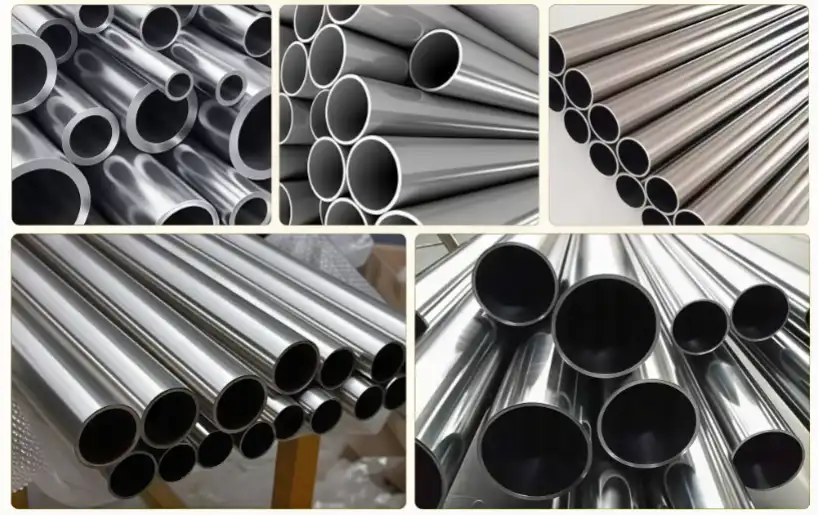
After being formed, each pipe goes through solution annealing at 1040°C–1150°C and then rapid cooling under force to lock in the alloy's austenitic structure and restore its highest level of corrosion resistance. Solution annealed and pickled (SA&P) finishes are good for industrial process lines. Bright annealed (BA) finishes are good for pharmaceutical and food-grade service, and mirror polished finishes (180# to 600#) are good for clean uses. For any weld-prep need, there is a regular end, a sharpened end to ASME B16.25, a threaded (NPT/BSPT) end, or a flanged end.
Corrosion Resistance of TP316L in Chemical Environments
Why Molybdenum Changes the Equation?
A lot of research in the journal Corrosion Science has shown that adding even 2% molybdenum raises the critical pitting potential of austenitic stainless steel by 150–200 mV in neutral chloride solutions. In real life, this means that 316L-grade pipe can handle acetic acid, sulfuric acid, phosphoric acid, and process brines that would quickly wear away 304-grade material and leave pits obvious. This is not a small benefit for chemical plant pipes that handle harsh chemicals; it makes the difference between a line lasting three years or fifteen.
Resistance to Post-Weld Degradation
Sensitization is a known way that welded process pipes can fail. This happens when carbon moves to the edges of the grains while they are being welded, creating chromium carbides that remove chromium from the nearby matrix and make way for rust to happen. Since TP316L stainless steel pipe has less than 0.03% carbon, this mechanism is stopped without the need for annealing after the welding process. The ASTM A262 Practice E (Strauss Test), which we use as a standard quality check, backs this up. This security means that site-welded parts, like heating network expansion joints and power plant tie-ins, will need less work and cost less to maintain over their lifetime.
Real Service Life Impact
When a petrochemical plant in the Yangtze River Delta moved its cooling water headers from carbon steel to 316L-grade seamless pipe, the time between repair visits due to rust went from 18 months to over 7 years. Individual results depend on fluid chemistry and operating conditions, but this kind of improvement is possible because of the metallurgy underneath. EN 10204 3.1 Mill Test Certificates give project owners the proof they need to believe material performance claims.
Comparing TP316L with Other Stainless Steel Pipe Types for Chemical Processing
TP316L vs. TP304: The Chloride Difference
TP304 is the most common austenitic grade, and it works well in mild conditions. But it doesn't have any molybdenum in it, so it can pit in chloride-containing environments above about 25°C. TP304 has a much higher chance of localized rusting in chemical plant lines carrying salty process streams or in ocean and coastal wastewater systems. TP316L is the recommended material when chloride content is an important part of the design. Procurement experts often check this against P&ID papers before approving material requests.
TP316L vs. Standard TP316
Standard TP316 and TP316L have almost the same level of corrosion resistance. The difference in real life is how well they can be welded. TP316 has a carbon limit of 0.08%, which is about twice as high as the L-grade's limit of 0.03%. The L-grade eliminates the risk of sensitization in heavily welded parts like header manifolds, reactor feed lines, or multi-branch tee configurations without the need for an extra heat treatment step. This makes things easier, which cuts down on installation time and gets rid of a possible quality audit point.
TP316L vs. Carbon Steel: Total Cost Perspective
The price per meter of carbon steel pipe is lower. When it comes into contact with chlorine process fluids or acidic chemical streams, however, it corrodes quickly, needing to be replaced often and costing a lot to fix. When procurement teams add up the total cost of ownership for corrosive uses, which includes inspections, replacement work, and process downtime, 316L-grade steel always comes out cheaper per year of service life. In order to explain the initial price premium to financial controllers, this is what materials managers say.
Sourcing and Procurement Guide for TP316L Stainless Steel Pipe
Key Standards and Certification Requirements
Asme SA312 and ASTM A312 standards should be followed for smooth and welded TP316L stainless steel pipe, ASTM A213 standards for heat exchanger and boiler tubes, and EN 10216-5 standards for European pressure equipment. The EN 10204 3.1 Mill Test Certificate is a required document for business-to-business purchases. It shows the heat number, chemical analysis, and mechanical test results that can be linked to the specific production batch. Owners of projects in the Middle East and Southeast Asia often ask for independent proof from SGS, BV, TÜV, DNV, or ABS.
Dimensional and Processing Verification
Before placing a large order, check the following against your drawing BOM:
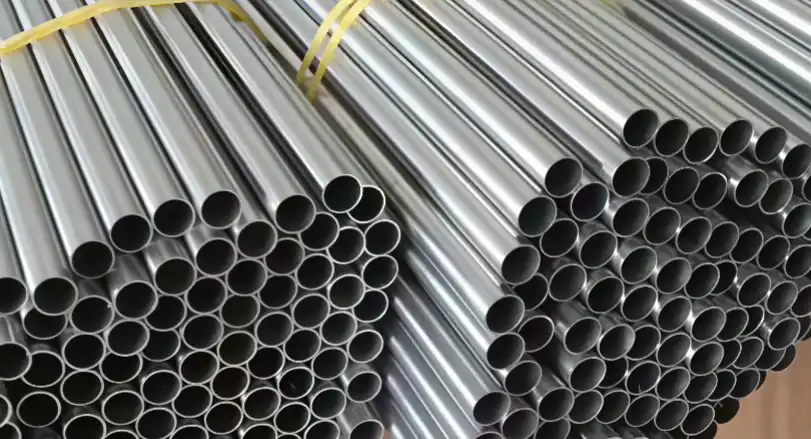
- Outer diameter and wall schedule: OD range 13.7 mm to 609.6 mm; wall thickness from SCH 5S (0.5 mm) through XXS (up to 50 mm).
- Bevel end preparation: Must conform to ASME B16.25 to ensure weld fit-up without site grinding.
- Non-destructive testing coverage: Hydrostatic test, eddy current test, and ultrasonic test should all be documented in the MTC package.
- PMI verification: Positive Material Identification confirms molybdenum and nickel content on every batch, not just sample pieces.
The MTC package should include information about the hydrostatic test, the eddy current test, and the ultrasonic test. These are all types of non-destructive testing.
Positive Material Identification (PMI) checks the amount of molybdenum and nickel in every batch, not just sample pieces.
Trusted TP316L Stainless Steel Pipe Manufacturers: Why All Trust Stands Out?
There's more to picking a supplier than just comparing prices. If a project finishes on time, it depends on consistent batch chemistry, reliable delivery dates, and complete documentation.
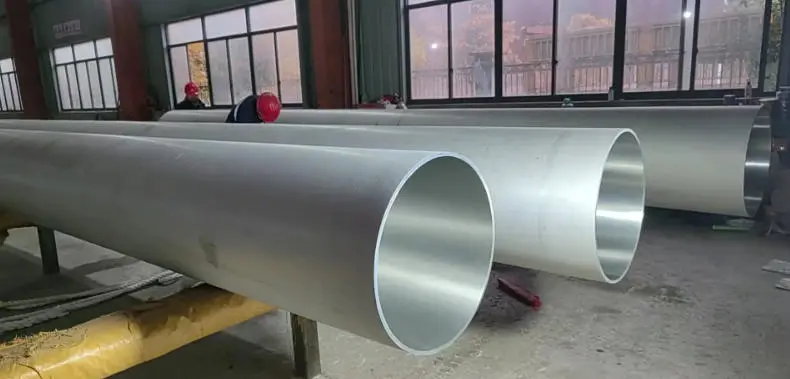
Hebei All Trust Steel Co., Ltd. has been in business since 2006 and can make steel with a maximum outside diameter of 1,016 mm. Each year, they produce more than 15,000 tons. The quality system has a four-step control process: an independent spectrographic analysis of the billet, production monitoring with laser dimensional verification, independent NDT testing that includes hydrostatic and eddy current testing, and a final audit of the documentation before shipment. Each order comes with a real EN 10204 3.1 MTC and a full PMI report.
Here are the benefits of buying that directly meet the needs of integrators:
- One-stop supply: Pipes, elbows, tees, reducers, and flanges consolidated into a single shipment, reducing LCL freight costs and procurement administration.
- Flexible lead times: Stock orders ship within 3–5 days; standard custom orders within 15–20 days; large engineering projects within 25–30 days.
- Beveled end compliance: All pipe ends are machined to ASME B16.25 as standard, eliminating site rework on weld preparation.
- Third-party inspection support: SGS, TÜV, and DNV inspections are accepted and coordinated without additional delay.
These features shorten the buying process from making the bill of materials (BOM) to inspecting the goods on-site, which usually takes one to three weeks for integrators who are shopping for busy project plans.
Conclusion
The reason TP316L stainless steel pipe is used in chemical processes is that it has a full schedule range that covers almost every pressure class, low-carbon weld safety, and molybdenum-driven salt protection. The grade's resistance to post-weld degradation and chloride pitting lowers the frequency of upkeep and the total cost of ownership for procurement teams working on projects in chemical plants, municipal heating networks, or power plant pipes. Before buying in bulk, making sure the material has EN 10204 3.1 certificates and PMI tests protects against batch inconsistency, which is what causes most of the expensive rework that needs to be done on-site.
FAQ
What is the difference between TP316 and TP316L pipe?
TP316L holds carbon to a maximum of 0.03%, compared to 0.08% for standard TP316. This lower carbon level prevents carbide precipitation at grain boundaries during welding, eliminating the sensitization risk that can lead to intergranular corrosion in welded assemblies. For heavily welded chemical plant piping, the L-grade removes the need for post-weld annealing.
Can 316L-grade stainless pipe handle sulfuric acid service?
Yes, at low to moderate concentrations and ambient to moderate temperatures. At higher concentrations or elevated temperatures, specialty alloys such as 904L or 254SMO may be required. A corrosion resistance chart specific to the acid concentration and temperature should be reviewed during the design phase.
What non-destructive tests should I request?
Standard practice includes hydrostatic pressure testing, eddy current testing for surface and subsurface flaws, and ultrasonic testing for wall thickness uniformity. For welded pipe, radiographic testing (RT/X-ray) adds further weld seam verification. All results should appear in the MTC package.
How do I confirm I am receiving genuine TP316L material?
Request a PMI (Positive Material Identification) test on delivery, and cross-reference the heat number stamped on each pipe with the EN 10204 3.1 MTC supplied by the mill. Independent third-party inspection by SGS or TÜV before shipment provides an additional layer of verification.
What surface finish is standard for chemical process lines?
Solution annealed and pickled (SA&P) is the standard industrial finish for chemical process piping. It removes oxide scale and restores the passive chromium oxide layer. Bright annealed (BA), or mirror-polished finishes are specified for pharmaceutical, food, or high-purity water applications.
Get TP316L Stainless Steel Pipe Quotes from All Trust — Fast Response, Full Certification
Since 2006, All Trust has sold certified TP316L stainless steel pipe to engineering firms, companies that make pressure vessels, and companies that put together pipes. As a 316L stainless steel pipe provider, we have NPS 1/8" through 48" in stock, in all schedules, and with full PMI paperwork and EN 10204 3.1 MTC on every order. One-stop supply has elbows, tees, reducers, and flanges that all match from the same batch. For project details and prices, email our technical team at info@hballtrust.com or go to hballtrust.com. Response to quote within 8 business hours.
References
1. ASM International. ASM Handbook, Volume 13A: Corrosion: Fundamentals, Testing, and Protection. ASM International, 2003.
2. ASTM International. ASTM A312/A312M: Standard Specification for Seamless, Welded, and Heavily Cold Worked Austenitic Stainless Steel Pipes. ASTM International, 2022.
3. Sedriks, A. J. Corrosion of Stainless Steels, 2nd ed. John Wiley & Sons, 1996.
4. Lippold, J. C., and Kotecki, D. J. Welding Metallurgy and Weldability of Stainless Steels. John Wiley & Sons, 2005.
5. Corrosion Science, Elsevier. "Effect of Molybdenum on Pitting Corrosion Resistance of Austenitic Stainless Steels in Chloride Solutions." Vol. 50, 2008.
6. The Nickel Institute. Guidelines for the Welded Fabrication of Nickel-Containing Stainless Steels for Corrosion Resistant Services. Nickel Institute Publication No. 11007, 2020.

