Where Does TP316L Stainless Steel Pipe Improve Reliability in Chemical Processing?
When project managers and piping engineers ask where reliability truly matters in a chemical plant, the answer almost always comes back to material selection. TP316L stainless steel pipe — grade UNS S31603 / 1.4404 under ASTM A312 / ASME SA312 — delivers measurable performance advantages in environments where corrosive fluids, elevated temperatures, and weld-zone integrity cannot be compromised. Its ultra-low carbon content (max 0.03%) combined with 2–3% molybdenum makes it the go-to choice for chemical process lines, petrochemical refinery towers, and offshore fluid transport systems where standard grades simply fall short.
Understanding TP316L Stainless Steel Pipe in Chemical Processing
Chemical Composition That Targets Real Failure Modes
16–18% of the alloy is chromium, 10–14% is nickel, and 2–3% is molybdenum. Adding molybdenum isn't just for looks; it directly makes the passive film more stable in media that are high in chloride and acidic. The low carbon ceiling stops carbide from forming at the edges of grains while welding. This is the exact process that breaks down standard 316 pipe after thermal cycling and leads to intergranular corrosion.
Mechanical Properties Under Process Conditions
Tensile strength can go as low as 485 MPa (70 ksi), and yield strength can't be lower than 170 MPa (25 ksi). These numbers are the same for all wall thicknesses, from SCH 5S to XXS. This lets stress engineers know what numbers to use when figuring out pressure. The austenitic microstructure also helps keep the temperature high for a long time, which is important for heat exchanger tubes and reactor bypass lines.
Applications Where These Properties Pay Off
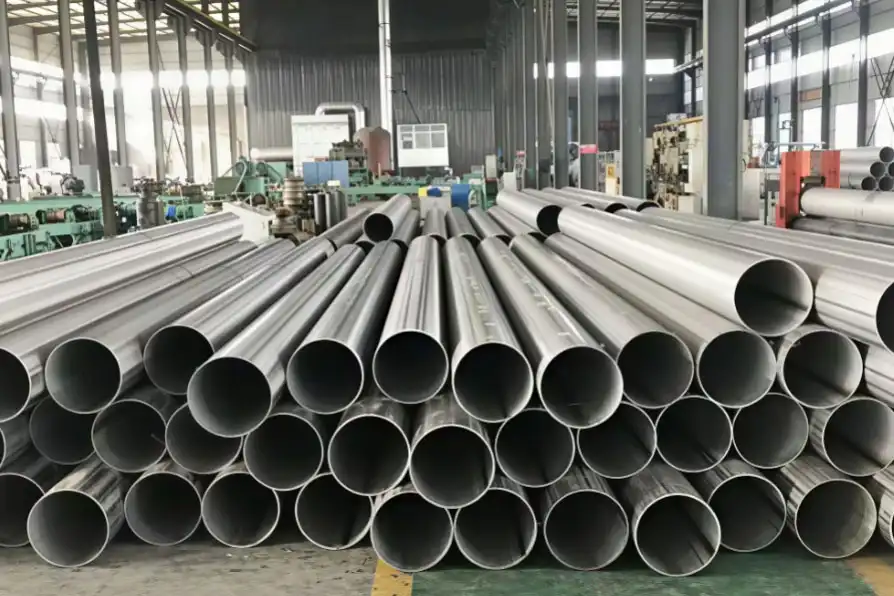
The pipe works with chemical process lines that carry diluted acetic acid, phosphoric acid, and sulfuric acid. It works in remote marine platform utility pipes, coastal wastewater treatment headers, and power plant condensate return systems. There is a single material standard for sizes NPS 1/8" through 48" and outer widths from 13.7 mm to 609.6 mm. This size range covers both instrument tubing and large-bore process headers.
Comparing TP316L Stainless Steel Pipe with Other Materials
TP316L vs. TP304 in Chloride Environments
Molybdenum is not in TP304. Even small amounts of chloride can cause pitting attack on TP304 within months in places like seaside plant cooling water and seawater-cooled heat exchangers. That pitting doesn't happen in TP316L because molybdenum keeps the passive layer stable in both oxidizing and reducing acid conditions at the same time. This difference is often what makes the difference between a system lasting five years or fifteen years for chemical plant acquisition engineers who are choosing pipes for chloride-bearing service.
TP316L vs. Carbon Steel on Total Cost of Ownership
The price per ton of carbon steel is lower, and many procurement managers feel that pressure when they are making a project bill of materials (BOM). When you take into account coating maintenance, planned replacement intervals, and unplanned shutdowns due to internal corrosion that lowers wall thickness below minimum, the math changes. Studies on the costs of chemical plant pipes over their entire lifetime consistently show that corrosion-resistant alloy TP316L stainless steel pipe in harsh service lowers total maintenance costs over a ten-year period, even if it costs three to four times as much at first.
TP316L vs. Duplex Grades for Standard Chemical Service
Duplex types, such as UNS S32205, have higher tensile strength and better protection against chloride stress corrosion cracking in harsh environments. They also cost more to make and need stricter controls when welding. For most chemical plant service conditions—moderate acid concentrations, temperatures below 300°C, and normal pressure classes—TP316L provides sufficient corrosion protection at a more affordable price, with a wider range of fittings available for easy one-stop shopping.
Enhancing Reliability Through Manufacturing and Quality Assurance
Process Controls That Define Pipe Quality
Before shaping, the quality of the production starts. Before any hot piercing or automatic longitudinal welding starts, billets from ISO-certified mills have their heat numbers backed up by spectrographic analysis. This checks the levels of chromium, nickel, molybdenum, and carbon against ASTM A312 standards. Laser measurement is used to keep an eye on the wall thickness and outer diameter tolerances during cold drawing. This makes sure that the dimensions are accurate for all schedules, from SCH 10S to SCH 160.
Heat Treatment and Surface Condition
After solution annealing at 1040°C–1150°C and forced fast uniform cooling, the austenitic microstructure is locked in place, and any carbide phases that formed during production are broken down. This step is necessary; it's the only way to tell the difference between a pipe that won't rust in the weld heat-affected zone and one that will fail in two years of chloride service. Solution annealed and pickled (SA&P) is one surface finish choice for industrial process service. Bright annealed (BA) is another, and mirror polished grades (180# to 600#) are for pharmaceutical or high-purity uses.
Certification and Traceability Requirements
Each batch of pipes comes with an EN 10204 3.1 Mill Test Certificate that lists the results of chemical tests, mechanical tests, heat numbers, and measurement checks. Non-destructive testing includes hydrostatic pressure testing, eddy current inspection for flaws on the surface and below the surface, ultrasonic testing for wall integrity, and X-ray examination when needed. You can request and get a third-party inspection by SGS, BV, TUV, DNV, or ABS. This is in response to buying requirements that say the goods must be checked by a third party before they are shipped.
Procurement Insights: Sourcing TP316L Stainless Steel Pipes for Chemical Processing
Evaluating Supplier Credibility Before Committing
Getting a chemical plant pipe package usually takes between one and three weeks, from when the bill of materials is submitted to when the order is placed. During that time, the most important thing to do is make sure that the seller can give you real EN 10204 3.1 MTCs with traceable heat numbers and not copies or new copies of the papers. Every bulk order of TP316L stainless steel pipe should come with Positive Material Identification (PMI) reports that confirm the molybdenum content. If a seller of 316L stainless steel pipes can't give you independent PMI data when you ask for it, they should be taken off the list.
Here are the main things that expert materials managers look at when they qualify a supplier:
- MTC authenticity: Heat numbers on the pipe markings must match the mill certificate exactly — verify this before acceptance.
- Dimensional compliance: Beveled ends must meet ASME B16.25 to avoid fit-up problems at weld joints; wall thickness must match mating fittings and flanges.
- One-stop consolidation: Sourcing pipes, elbows, tees, and reducers from a single supplier reduces batch inconsistency and simplifies on-site inspection.
- Lead time transparency: Stock orders should ship within 3–5 days; custom schedule or length orders within 15–30 days depending on volume.
The beveled ends must meet ASME B16.25 so that there are no fit-up issues at the weld joints. The wall thickness must also match the thickness of the fittings and flanges that go with them.
Packaging and Logistics for International Projects
Transit protection is just as important as mill quality for projects in the Middle East or Southeast Asia. Hexagonal steel bundles with high-tensile straps and plastic end caps keep the weld bevel surfaces and pipe bore state safe while they are being shipped by ocean. When stored in a port, a waterproof woven bag keeps salt and moisture from getting in. Combining packages of pipes, fittings, and valves lowers the cost of LCL freight and makes receiving at the site easier.
Real-World Impact: Case Studies and Performance Verification
Chemical Plant Acid Line Replacement
A chemical processing contractor who replaced corroded carbon steel acid transfer lines with UNS S31603 seamless pipe said that there were no shutdowns due to corrosion in the 36 months after the installation. Two emergency fixes were needed every year for the old carbon steel system. The intergranular attack that started in weld zones and spread during heat cycles was stopped when low-carbon molybdenum-bearing pipe was used instead.
Power Plant Condensate Return System
A project to upgrade the pipes in a power plant used SCH 40S TP316L welded pipe for the condensate return headers. The wall thickness numbers stayed the same during more than 200 weld checks, and there were no rejectable ultrasonic indications. The project team said that the high first-pass weld acceptance rates were due to consistent dimensions, especially the OD and wall tolerances that were kept during cold rolling.
Offshore Platform Utility Piping
Marine platform utility piping that was constantly sprayed with seawater showed no pitting after 24 months of service. This proved that the solution annealing and pickled surface finish kept the passive film integrity in real-world conditions. This directly cut the expected maintenance schedule for the platform by one inspection run per year.
Conclusion
Tp316l stainless steel pipe makes chemical processing more reliable at all system boundaries, where corrosion, weld integrity, and dimensional accuracy decide whether a pipe system works or not. Its ultra-low carbon chemistry gets rid of the risk of sensitization after welding. It stops chloride staining in active media because it has molybdenum in it. When made according to ASTM A312 standards and certified with full NDT, solution annealing, and EN 10204 3.1, it gives buying teams and site engineers the proof they need to decide to buy in bulk. Field installations always point to the same conclusion: better material quality at the start lowers the total cost of the project over its lifetime.
FAQ
What is the difference between TP316 and TP316L for chemical service?
TP316L has a maximum carbon content of 0.03%, compared to 0.08% for standard TP316. The lower carbon level prevents carbide precipitation at grain boundaries during welding, which protects the weld heat-affected zone from intergranular corrosion. For most welded chemical plant piping, TP316L is the specified grade.
Which schedules are available for TP316L pipe?
Wall thicknesses range from SCH 5S through SCH XXS, covering 0.5 mm to 50 mm. Size availability spans NPS 1/8" to 48" outer diameter, accommodating instrument lines through large-bore process headers.
What certifications should accompany a shipment?
Every batch should include an EN 10204 3.1 Mill Test Certificate with heat numbers traceable to the physical pipe markings. PMI analysis confirming molybdenum and nickel content, hydrostatic test records, and NDT reports (eddy current or ultrasonic) are standard documentation for chemical plant procurement.
Can third-party inspection be arranged?
Yes. Inspection by SGS, BV, TUV, DNV, or ABS is accepted and coordinated prior to shipment to align with project quality plans.
What end types are available for weld fit-up?
Beveled ends (BE) machined to ASME B16.25, plain ends (PE), threaded ends (NPT or BSPT), and flanged configurations are all available depending on system design requirements.
Request a Quote from All Trust — Your TP316L Stainless Steel Pipe Supplier
You can get certified UNS S31603 / Tp316l stainless steel pipe from All Trust (Hebei All Trust Steel Co., Ltd.) in all schedules and sizes. They offer EN 10204 3.1 MTCs, 100% PMI verification, and third-party inspection support. We ship from warehouses near Tianjin, Shanghai, and Qingdao, so we can meet the deadlines for projects of all sizes, from small stock sales to big EPC packages. To send us your BOM, please email us at info@hballtrust.com or go to hballtrust.com. We will get back to you within 8 hours.
References
1. ASTM International. ASTM A312/A312M: Standard Specification for Seamless, Welded, and Heavily Cold Worked Austenitic Stainless Steel Pipes. ASTM International, 2022.
2. Sedriks, A. J. Corrosion of Stainless Steels. 2nd ed. Wiley-Interscience, 1996.
3. Llewellyn, D. T., and R. C. Hudd. Steels: Metallurgy and Applications. 3rd ed. Butterworth-Heinemann, 1998.
4. NACE International. Corrosion Control in the Chemical Process Industries. 2nd ed. NACE International, 1994.
5. Birks, N., G. H. Meier, and F. S. Pettit. Introduction to the High-Temperature Oxidation of Metals. Cambridge University Press, 2006.
6. Schweitzer, Philip A. Corrosion Engineering Handbook: Corrosion of Linings and Coatings. CRC Press, 2006.

